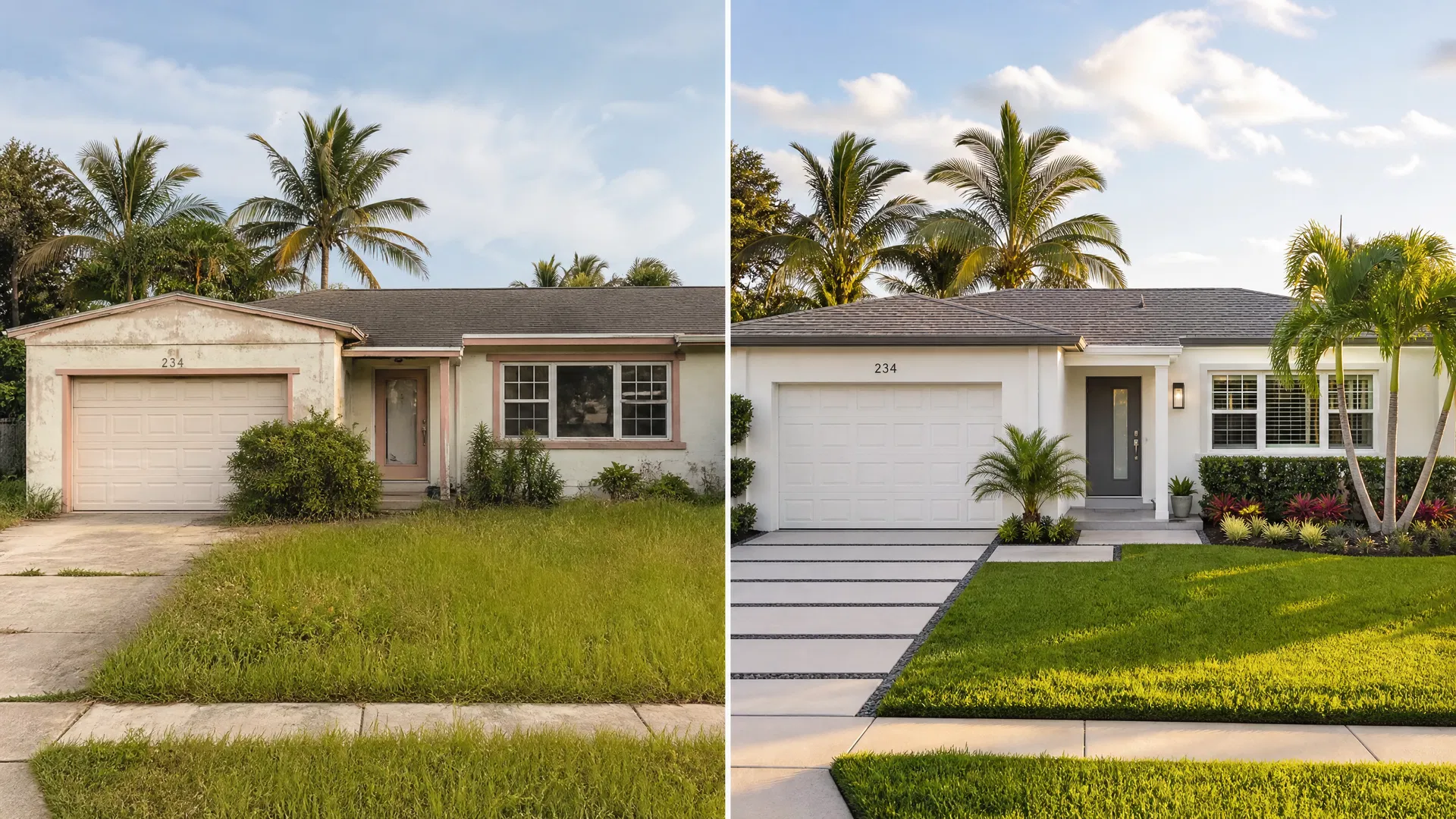
The Question Every Executor Faces
You've inherited a property. Maybe it's been well-maintained. Maybe it hasn't seen an update since 1987. Either way, you're facing the same fundamental question: do you sell it exactly as it sits, or do you invest in improvements to potentially get a higher price?
This isn't a question with a universal answer. It depends on the property's condition, the local market, the price point, the timeline, and the carrying costs you're absorbing every month you hold. What I can tell you from years of handling probate and inherited property sales across Palm Beach County and Broward County is this: the right answer is almost always somewhere in the middle — and it's almost never what people expect.
Why "Just Fix It Up" Is Often the Wrong Instinct
When families inherit a property that looks dated or needs work, the natural instinct is to renovate before selling. It feels logical — a nicer house should sell for more money. But in practice, this instinct leads to one of the most common and costly mistakes in inherited property sales.
Here's why:
You don't live there. Renovating a property you occupy is one thing. Managing a renovation remotely on a property you've inherited — coordinating contractors, making design decisions, handling permits, dealing with surprises behind walls — is an entirely different challenge. Every week of renovation is another week of carrying costs. Not all improvements return their cost. A $40,000 kitchen renovation in a neighborhood where homes sell for $300,000 might return $25,000 in added value. You just lost $15,000 plus three months of carrying costs. Meanwhile, a $3,000 landscaping refresh and $2,000 in cosmetic updates might have added $15,000 to the sale price with a two-week turnaround. The market dictates what matters. In some South Florida neighborhoods, buyers expect move-in ready and will pay a premium for it. In others, investors are actively competing for properties they can renovate themselves — and they're paying strong prices for as-is condition. Knowing which market you're in changes everything.When Selling As-Is Makes the Most Sense
Selling as-is doesn't mean selling at a discount. It means selling the property in its current condition without making repairs or improvements. In many situations, this is the smartest financial decision for the estate.
As-is typically makes sense when:- The property needs major structural work (roof replacement, foundation issues, significant plumbing or electrical problems) where repair costs are high and returns are uncertain
- Carrying costs are substantial and every month of holding erodes the estate's net proceeds
- Multiple beneficiaries need a faster resolution and extended timelines create family tension
- The property is in a price point or neighborhood where investor buyers are active and competitive
- The executor is out of state and managing a renovation remotely would be impractical
- The estate needs liquidity for other obligations (debts, taxes, distributions)
When Strategic Improvements Make Sense
On the other end of the spectrum, there are situations where targeted improvements genuinely increase the net proceeds to the estate — sometimes significantly.
Strategic improvements typically make sense when:- The property is in a desirable neighborhood where buyers expect move-in ready condition (Lighthouse Point, Boca Raton, Delray Beach, eastern Fort Lauderdale)
- The improvements needed are cosmetic, not structural — paint, flooring, landscaping, fixture updates
- The cost of improvements is low relative to the expected increase in sale price
- The timeline for improvements is short (2-4 weeks, not 2-4 months)
- The property's "bones" are good but the presentation is dated
| Improvement | Typical Cost | Typical Return | Timeline |
|---|---|---|---|
| Fresh interior/exterior paint | $3,000 - $8,000 | 150-300% return | 1-2 weeks |
| Landscaping refresh & curb appeal | $2,000 - $5,000 | 200-400% return | 1 week |
| Deep cleaning & decluttering | $1,000 - $3,000 | High perceived value | 2-5 days |
| Updated light fixtures & hardware | $500 - $2,000 | 200-300% return | 1-2 days |
| Minor kitchen updates (no gut reno) | $3,000 - $8,000 | 100-200% return | 1-2 weeks |
| Bathroom refresh (re-grout, fixtures, mirror) | $1,000 - $3,000 | 150-250% return | 3-5 days |
- Full kitchen gut renovations ($30,000-$80,000 with uncertain returns)
- Adding a pool (costs $40,000-$80,000, rarely returns full investment)
- Major structural repairs on properties in lower price points
- High-end finishes in neighborhoods that don't support premium pricing
- Any improvement that takes more than 4-6 weeks to complete
The Decision Framework I Use With Every Client
When I evaluate an inherited property, I walk through a specific process to determine the right path. It's not about pushing one option over another — it's about running the numbers honestly and letting the data guide the decision.
Step 1: Determine current as-is market value. What would this property sell for today, in its current condition, based on recent comparable sales in the immediate area? Not a Zillow estimate — actual closed sales of similar properties. Step 2: Identify the realistic improved value. If specific improvements were made, what would the property likely sell for? This requires understanding what buyers in that specific neighborhood are paying for updated homes versus dated ones. Step 3: Calculate the true cost of improvements. Not just the contractor's quote — but the carrying costs during renovation, the risk of unexpected issues, the time investment, and the opportunity cost of delayed proceeds. Step 4: Compare net proceeds. After subtracting improvement costs and additional carrying costs from the improved sale price, is the estate actually netting more than a faster as-is sale? Sometimes the answer is yes by a meaningful margin. Sometimes it's a wash. And sometimes the as-is path actually puts more money in the beneficiaries' pockets. Step 5: Factor in the human element. Numbers matter, but so does the family's situation. If beneficiaries are in financial hardship, if there's tension between heirs about what to do, if the executor is overwhelmed — these factors legitimately influence the right decision.How These Decisions Play Out in Practice
To illustrate how this framework applies, here are a few common scenarios that come up regularly in South Florida probate and inherited property sales:
Scenario 1: A dated but solid home in a desirable area. Imagine a three-bedroom, two-bath home that hasn't been updated since the early 2000s. Good bones, good location, but a dated kitchen, old carpet, and tired landscaping. In a situation like this, investing around $12,000 in paint, new flooring, landscaping, and minor kitchen cosmetics could result in a sale price $40,000-$50,000 above comparable as-is sales in the area. That's a strong net gain to the estate after improvements — and the prep timeline is typically just 3-4 weeks. Scenario 2: A property with significant deferred maintenance. Consider a home where the roof is 20+ years old, the AC unit is failing, and plumbing has known issues. Estimated repair costs might run $45,000-$60,000, but the after-repair value would only be approximately $40,000 higher than as-is value. The math doesn't work. In cases like this, selling as-is to a qualified buyer who plans their own renovation makes more sense. The estate avoids months of carrying costs, contractor headaches, and renovation risk — and the family receives proceeds faster. Scenario 3: A clean condo that just needs presentation. Sometimes the answer is simple. A well-maintained unit that just needs decluttering and a deep clean — maybe $2,000-$3,000 in total prep — can sell within two weeks at full market value. Not every inherited property needs a major decision. Some just need to be presented properly, not renovated.The Carrying Cost Factor Most People Underestimate
Here's what often tips the scale toward a faster sale: every month you hold an inherited property in South Florida, you're paying for it. Property taxes, insurance, utilities, HOA fees, lawn care — these add up to $2,000-$5,000+ per month depending on the property.
A three-month renovation that costs $25,000 in improvements also costs $6,000-$15,000 in carrying costs during that period. So your true investment isn't $25,000 — it's $31,000-$40,000. Does the improved sale price justify that total number? Sometimes yes, sometimes no. But you can't make that decision without accounting for carrying costs honestly.
You Don't Have to Decide Alone
This is exactly the kind of evaluation I do for every inherited property I work with. There's no agenda — I don't benefit from pushing you toward as-is or toward improvements. My job is to give you honest numbers, show you the options clearly, and help you make the decision that puts the most money in the estate's pocket with the least amount of stress and risk.
Every property is different. Every family's situation is different. But the framework for making a good decision is the same: get accurate data, run the numbers honestly, and factor in the full picture — not just the sale price, but the costs, timeline, and human factors that surround it.
Ready to get a clear picture of your options? Call or text (561) 654-1101 for a free property evaluation and honest assessment of what makes sense for your situation.